Early warning that sees drift before a threshold trips.
A threshold alert fires after something has already gone wrong. Early warning looks at where each thing is heading and compares that with where it should be, so you see trouble while it is still small. It also tells you how far ahead its judgment can be trusted.
In plain termsInstead of an alarm that rings when the limit is passed, a tool that notices you are drifting toward the limit.
Three ingredients
The mechanism, without the mechanics.
An expected path
The platform knows how each entity should evolve (its normal behavior, its schedule, its seasonality) because the business declares it rather than waiting for a model to discover it.
An observed path
Your live events tell the platform what each entity is actually doing.
The divergence
The difference between the two is the signal. It is continuous, it has a magnitude and a direction, and it exists before any static threshold is crossed, because thresholds are fixed and behavior is not.
Add a declared horizon, and you can say not just something is happening but here is how far ahead this judgment holds.
What an early warning must contain to be useful
Otherwise it is just another alert.
| Element | Why it is required |
|---|---|
| The entity | Warnings about aggregates are not actionable. |
| The forward position | Not the current value: where it is heading. |
| Direction and rate | Rising and falling are different problems. |
| Time at risk | A slow slide and a spike can share a value and mean entirely different things. |
| The evidence | What supports it, and how much the sources disagree. |
| Value at stake | So the queue can be worked top-down. |
| The cost of waiting | So “do nothing” is a priced option, not a default. |
Most alerting systems supply one of these. A warning without value at stake is a queue nobody can prioritize, and that is how alert fatigue starts.
Designed against alert fatigue
The most common reason early-warning deployments die is volume without ordering.
- Ranked by value at stake, not by deviation. The team works top-down, and the top is usually right.
- Conflict is surfaced. A contentious entity is flagged as contentious rather than smoothed into a confident average that is wrong in both directions.
- Volume is rationed by policy. Notification limits are a configured control, because a system that can send unlimited warnings will be muted.
- Time at risk separates persistence from noise. A one-tick blip and a three-day slide are not the same event, even at the same value.
- Warnings can be declined with a reason, and the decline is recorded, so tuning happens against evidence instead of opinion.
Early warning is not only bad news
The same machinery detects an entity moving favorably faster than its baseline. A platform that only warns about downside trains the business to associate it with bad news, and it gets ignored. Surfacing the upside is what keeps the downside warnings credible.
| Direction | Movement | Example |
|---|---|---|
| Deteriorating | Protect | Payment integrity declining in a store cluster |
| Improving | Grow | A cohort’s engagement climbing faster than its pattern |
| Degrading | Operate | Throughput or yield softening on a line |
Early warning, ranked by value at stake
The warnings arrive as a queue ordered by what each one costs if ignored, not by how unusual it looks.
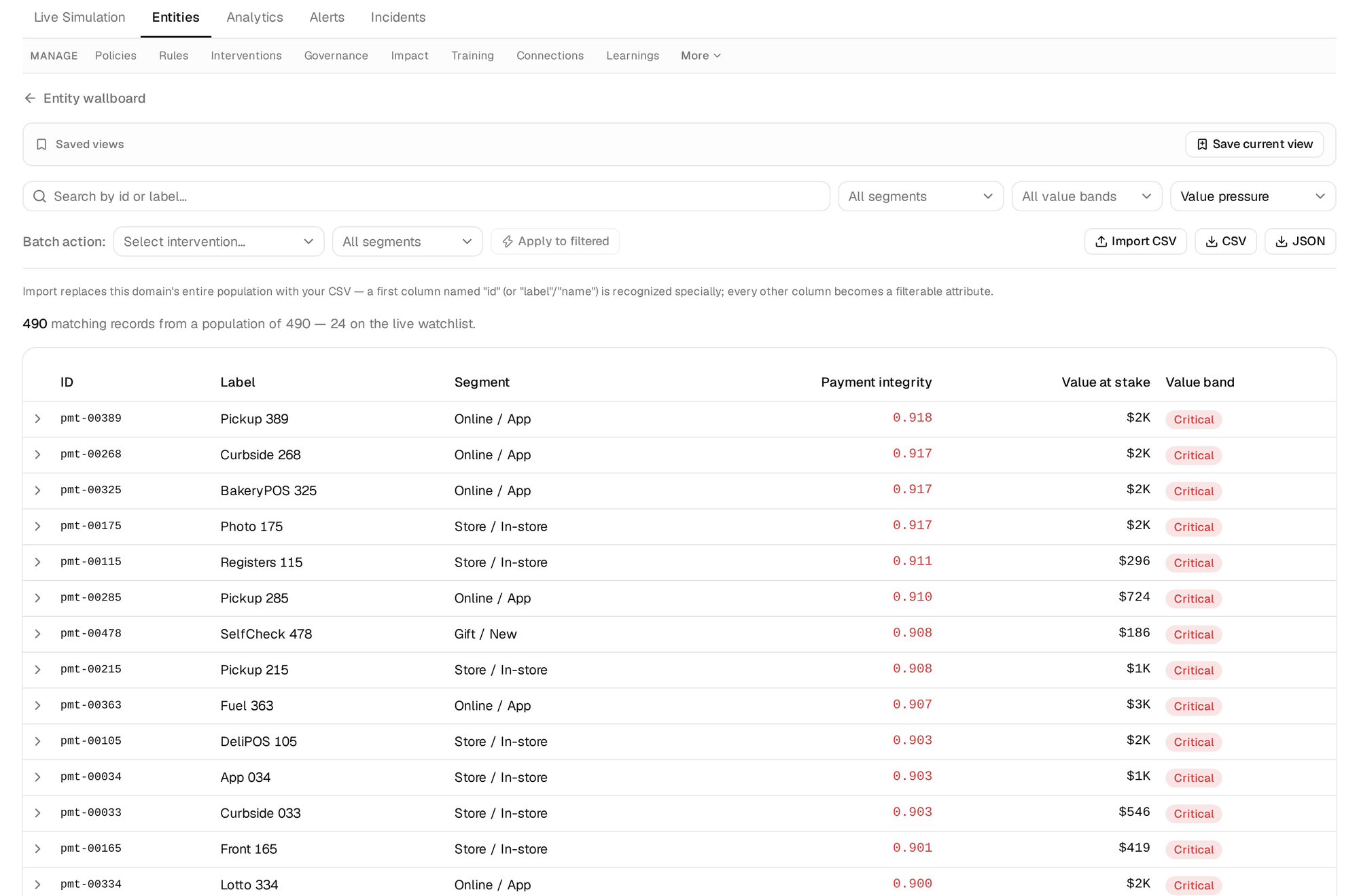 Fictional reference world: OgMart
Find out when your entities started drifting
Bring a month of real events from one domain. We will show you where the expected and observed paths parted, and how far ahead the model is genuinely useful.