Your operation is telling you something. You find out on Monday.
AnantState keeps a live picture of everything you run: every store, account, machine and case. For each one it shows where it is heading, what it costs to act now, and what it costs to wait. In dollars, not in a score.
In plain termsEach thing you manage is an entity. Its state is simply where it stands now and which way it is moving. Think of a flight tracker for your business.
Not ready to book? Take the 3-minute tour or download the evaluation checklist.
- 100 stores
- OgMart reference world, 15 departments, live. Fictional.
- Per-entity state
- A forward position for every entity, every tick.
- Priced action
- Cost to act and cost to wait, side by side.
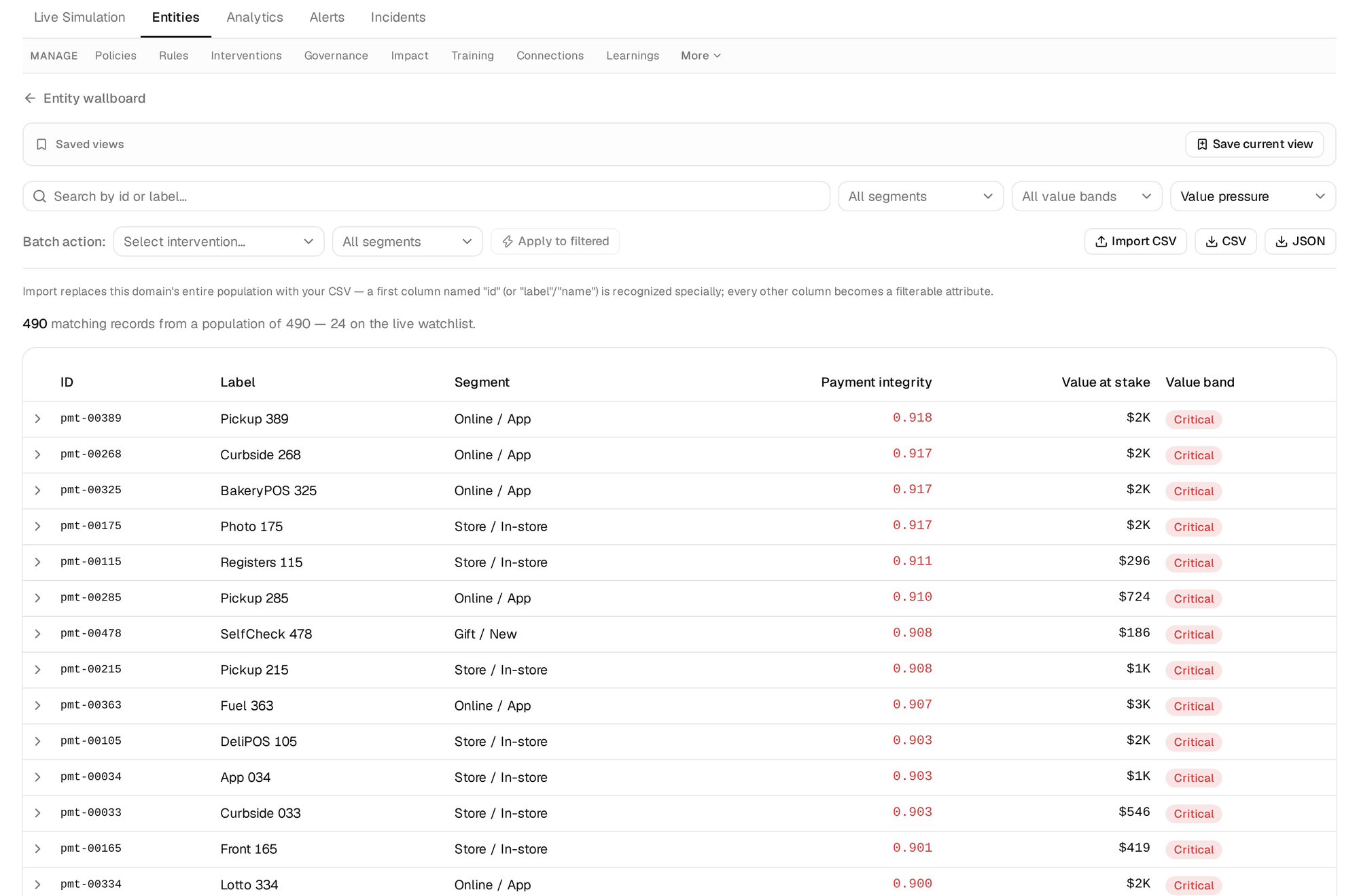 Fictional reference world: OgMart
Three things every operations leader says
Every one of those is a state problem, not a data problem. You have the data.
What AnantState actually does
Track each thing, not just the totals
Every store, account or machine gets a live position and a direction, not a score. Your own knowledge of how it normally behaves moves it forward, and a small learned part corrects it. You get something usable on day one and something sharper every week after.
Look ahead as far as you need
You say how far ahead you need to be right: tomorrow, next week, next quarter. The platform tests itself at exactly that distance against the simplest guess, “nothing will change”. If it cannot beat that guess, it tells you, in plain language.
Put a price on the decision
Actions cost money. So does waiting. Every recommendation shows both, so the decision is argued on the numbers instead of on conviction.
Told in momentum, not in risk-speak
Most platforms describe your business as a wall of risk. We describe it as five movements.
- Protect
What are we about to lose, and where?
Entities drifting toward a costly state, ranked by value at stake.
- Grow
Where is value building that we should lean into?
Entities improving faster than their baseline, with the driver named.
- Operate
What is degrading or blocking throughput?
Rising cost-to-serve, stuck cases, degrading equipment.
- Value
What is this worth, in currency, if we act?
Expected recovery against spend, per action and in aggregate.
- Allocate
Where should the next unit of attention go?
A ranked queue with the economics already attached.
Explainable AI. Not a language model. Not token-based.
No prompts. No generated text. No token meter. Nothing here invents an answer, because nothing here generates one. Every conclusion is derived from explicit state and evidence, and can be traced, reproduced and audited.
And the honest part, which is what makes the rest credible: there is a learned component. It is a bounded, weighted correction to your own declared dynamics, not a generative black box. Its influence is visible per metric, and you set how much to trust it.
| Your risk function will ask | The answer |
|---|---|
| Will the same inputs give the same answer tomorrow? | Yes. Reproducible by construction. |
| Can we see why? | Every conclusion traces back through its evidence. |
| Does anything get generated? | No. There is no generative component in the platform. |
| Who decides what it is allowed to do? | You. Authority is granted per action class, not globally. |
In the product
Real screens from OgMart, our fictional reference world.
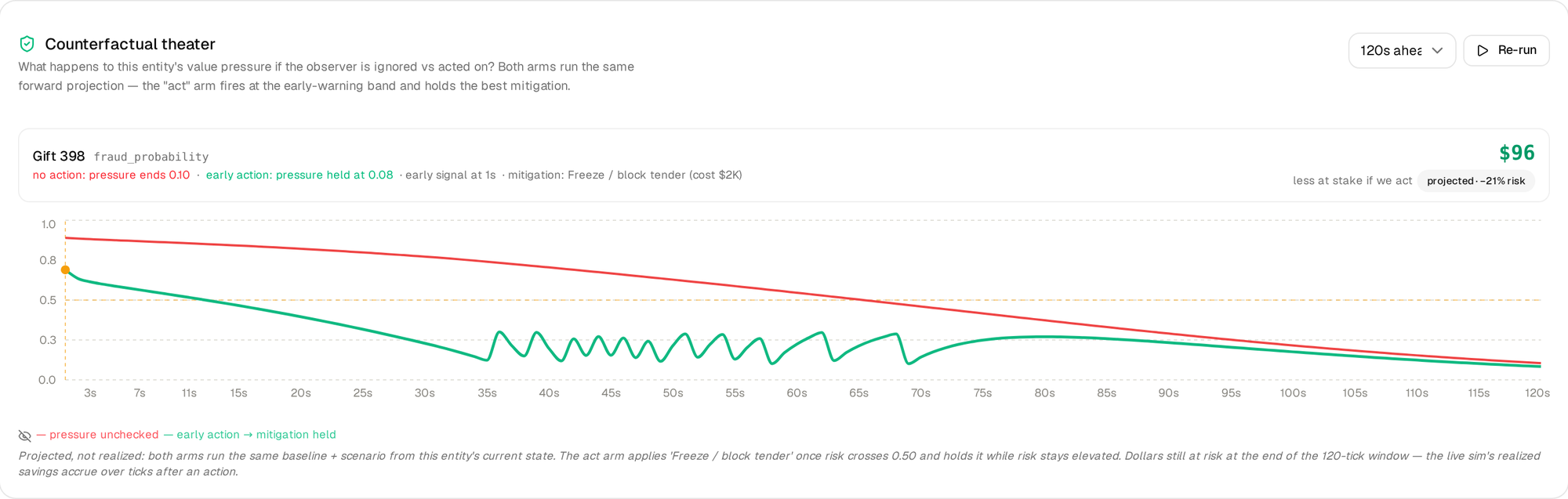 Fictional reference world: OgMart
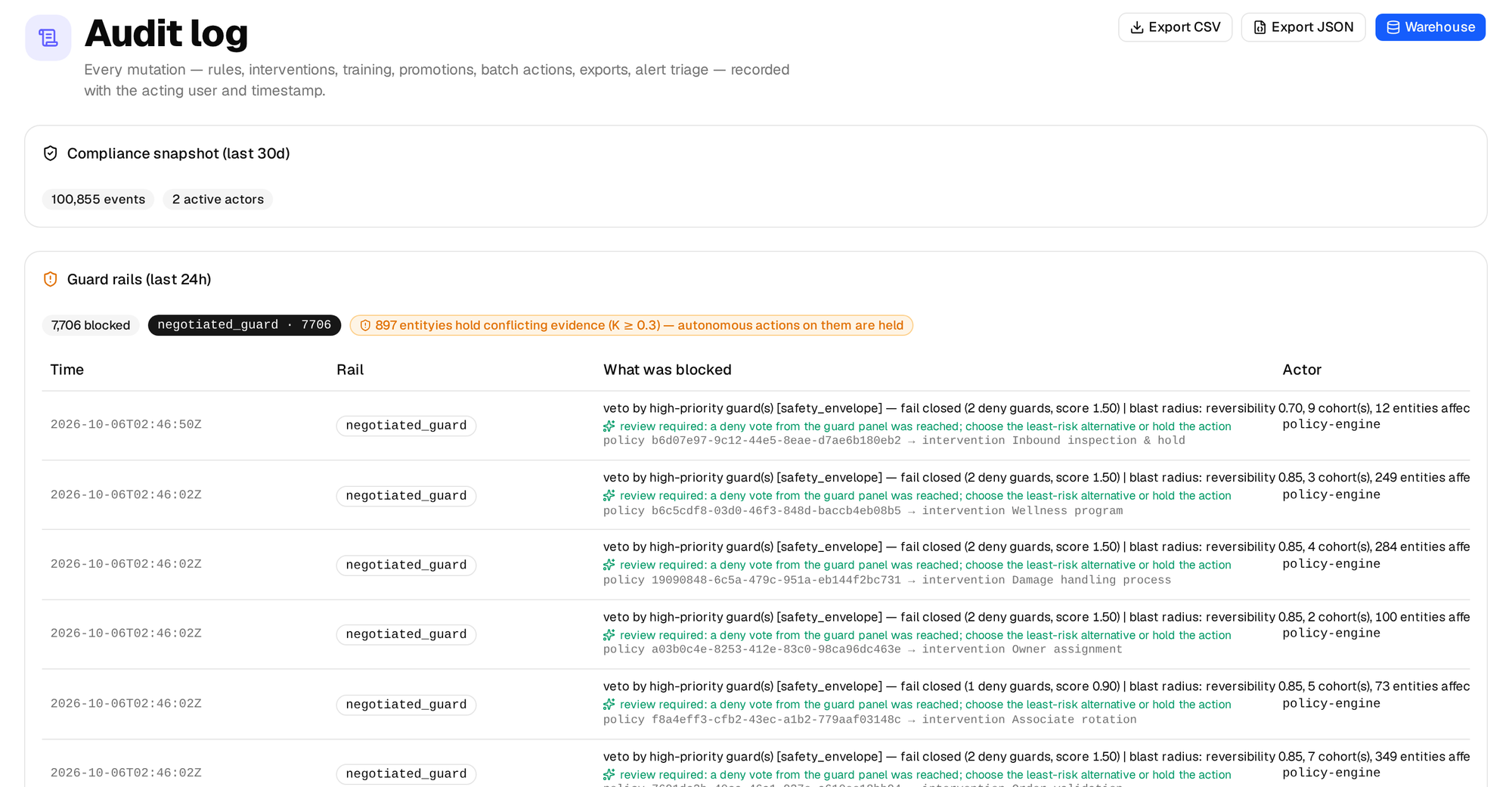 Fictional reference world: OgMart
Start narrow. Read the record.
One domain, a sample of real events, a horizon you declare, and a model record that includes where it loses.
Pick one domain
The thing your team already argues about weekly.
Bring a month of events
Enough to judge the shape.
Declare the horizon
How far ahead you need to be right.
Read the model record
Losses included.
You already own most of the stack.
AnantState does not replace your dashboards, rules or monitoring. It adds the one thing none of them has.
The engine does not change. The world does.
We publish where the model fails
Any vendor can show you a model that looks good. Ask them for the horizons where it does not. We put that in the model record, because a platform you cannot audit is a platform you cannot deploy.
Model report card · illustrative shape, not a measured result
- 1 stepPassed
- 5 stepsPassed
- 20 stepsFailed
- 50 stepsThis horizon was never evaluatedNot measured
- Tenant isolation enforced in the database
- Promotion gate: no model serves without beating its baseline at your declared horizon
- Every action attributed in a tenant-scoped audit trail
- Runs beside your systems; no change to your POS, EHR or MES
Bring a world we have not seen
The fastest way to judge this is to watch it run on something you recognize. Bring one domain, a sample of real events, and the decision you wish you could make earlier. We will stand it up in the session.