It works before you have history. It sharpens as you build it.
Most prediction tools are useless until you have years of labeled history. AnantState starts working on day one, because you tell it how your business normally behaves instead of waiting for a model to work that out. As real history builds up, it gets sharper.
In plain termsYou start with what you already know about your business. The system learns the rest from your data over time.
Two sources of knowledge: declared, then observed
Declared knowledge is the ontology: what the entities are, what state they carry, how state moves when nothing unusual happens, what actions exist and what they cost. It is knowledge your organization already has, and it is the reason deployment does not begin with a data project.
Observed knowledge is what actually happens: where entities diverge from their declared behavior, which patterns recur, what interventions deliver, and what the outcomes were. It is knowledge only your data has, and it is what fine-tuning adds.
The declared dynamics carry the state; the observed component corrects it. The correction is bounded, weighted and visible, so it can only add information, never quietly replace the business’s understanding of itself.
What “without historical data” buys you
Three things you can do on day one.
See forward positions immediately
Every entity has a state and a direction from the moment the ontology is defined and events start arriving. No cold-start period of blindness.
Evaluate honestly, immediately
The platform measures its forward error against a naive baseline from the first day. You learn whether this will work in your domain on a small evaluation, not after a two-year data program.
Run the twin before the model is mature
What-if, impact analysis and counterfactual replay all work on declared dynamics. They get better with learning; they are not blocked without it.
That changes the shape of a deployment: the business gets value in the first weeks and the model catches up, rather than the business waiting for the model.
What fine-tuning adds
| Gains from observed history | Effect |
|---|---|
| Sharper divergence detection | Smaller, earlier deviations become distinguishable from noise. |
| Domain-specific dynamics | The declared baseline is corrected for your actual operating regime. |
| Calibrated expectations | Modeled effects are compared against realized outcomes from memory. |
| Recurring-pattern recognition | Repeated patterns are recognized as patterns rather than as new anomalies. |
| Cross-entity learning | What is learned about one entity informs the population it belongs to. |
Fine-tuning is not a rewrite. It adjusts a bounded correction to a system that already works, which is why it can be done incrementally, evaluated honestly, and reversed if it does not help.
Continuous, but not unsupervised
Learning is continuous. Promotion is governed.
A newly trained version does not become the serving version because it finished training. It must pass a gate that checks, in order: that the training data is attributable and not dominated by the model’s own prior output; that the output is well-behaved; that it beats a naive baseline rather than its previous version; and that the horizon the business requires was actually measured. If it was not, that is recorded as not measured, never as a pass.
A human may override a refusal. The override is attributed and recorded. The platform’s default is to refuse; using a model that failed its gate is a decision someone owns by name.
The promotion gate refuses in a fixed order
- 1 · Corpus provenance
- 2 · Divergence
- 3 · Beats persistence
- 4 · Declared horizon measured
- Serve
The default posture is to refuse. A human can override, and the override is recorded with the actor and the reason.
Declared first, corrected second
The baseline carries the state from day one; the learned part corrects only what is left over.
Learning is judged, not assumed
A trained model is measured against a baseline before it may serve.
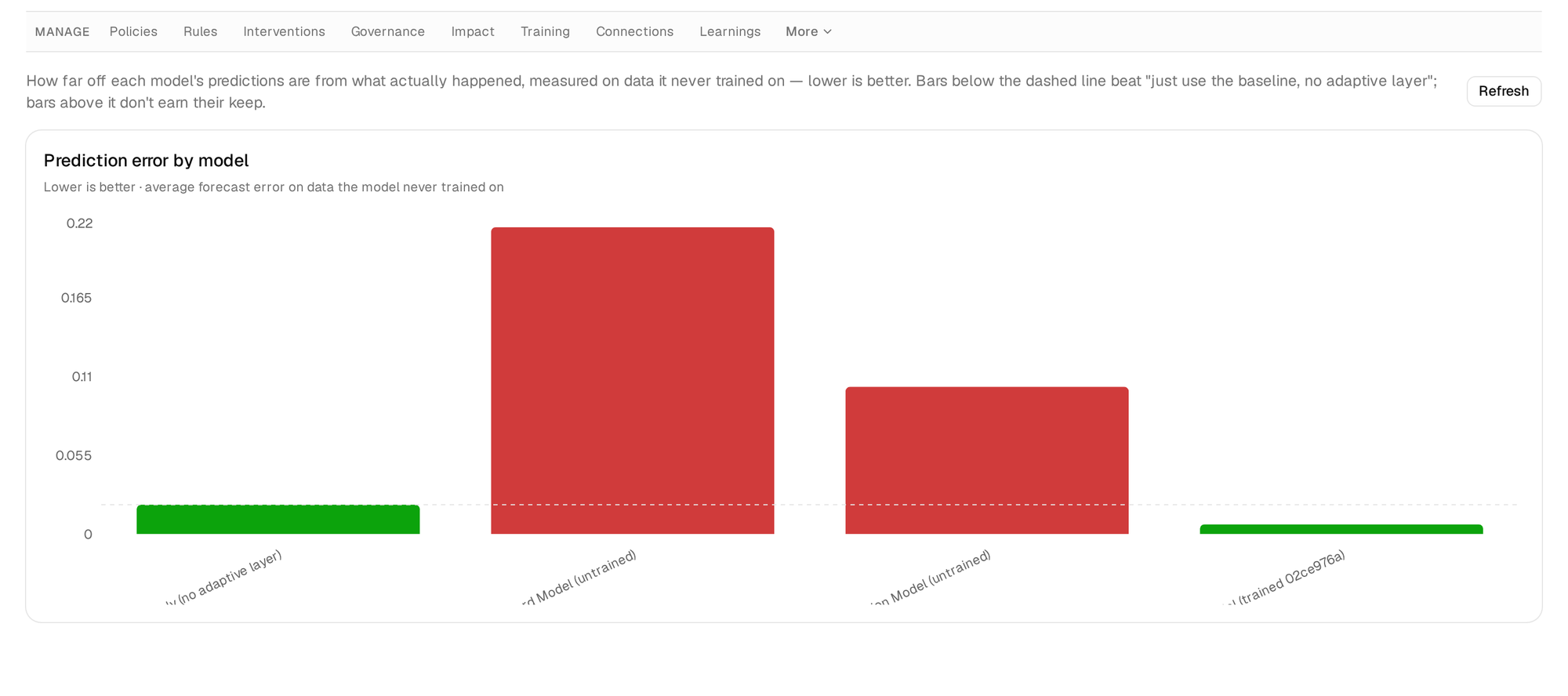 Fictional reference world: OgMart
Find out in a month whether it learns anything in your domain
A sample of real events is enough to judge whether the learned correction adds information. The model record tells you either way.