A hundred stores is a hundred live situations.
A hundred stores is a hundred live situations. One compromised till is a local problem; the same pattern across a dozen stores is organized fraud. You cannot see the second thing if you look at stores one at a time.
In plain termsSpot patterns that only appear when you look across stores, and price the response.
1 · What are the things you manage?
Retail is unusual in that its entities are independent in space and coupled in money.
- Store
- Payment lane
- Till
- Online checkout
- Member account
- SKU at location
- Delivery route
2 · What changes over time, and why?
| State | What moves it (baseline) | What moves it unexpectedly (residual) |
|---|---|---|
| Payment integrity | Transaction volume, trading hours, basket mix, seasonality | Tender manipulation, card testing, chargeback patterns |
| Refund pressure | Returns policy, season, product mix | Refund abuse, staff collusion |
| Gift-card exposure | Promotions, holiday cycles | Draining, cloning, bulk activation |
| Availability | Replenishment schedule, demand | Supplier failure, mis-picked distribution |
| Store posture | Footfall, staffing, day of week | Localized fraud clusters, equipment failure |
The baseline part is genuinely most of it: retail state is dominated by schedule and season. The learned residual exists to catch the part that is not scheduled, which is exactly the part that costs money.
3 · What goes wrong today?
In the buyer’s own words.
4 · What changes with AnantState?
- Entity state per lane, store and account, not per transaction. The unit of attention matches the unit of management.
- A forward position per entity, so a store drifting toward a costly state is visible while it is still cheap.
- Cross-entity patterns. When several entities share a driver, that is visible as state correlation rather than as coincidental alerts.
- Priced interventions. Block a tender, review an account, restrict a lane, each with its cost and modeled effect.
- Cost of waiting, so the “do we block it?” argument has a number in it.
- Replay and what-if, so a policy change can be evaluated against the current population before it is applied.
5 · What can you see in the demo?
OgMart, a fictional 100-store, 1–2 billion USD mini-Walmart across 15 departments, running live. What you can watch:
- entities ranked by value at stake, with band and trend
- a selected entity’s state trajectory against its events
- an intervention’s expected effect and its cost, side by side
- the what-if, recomputed in your own browser
OgMart is fictional and labeled as such. The mechanics are real; the company is not.
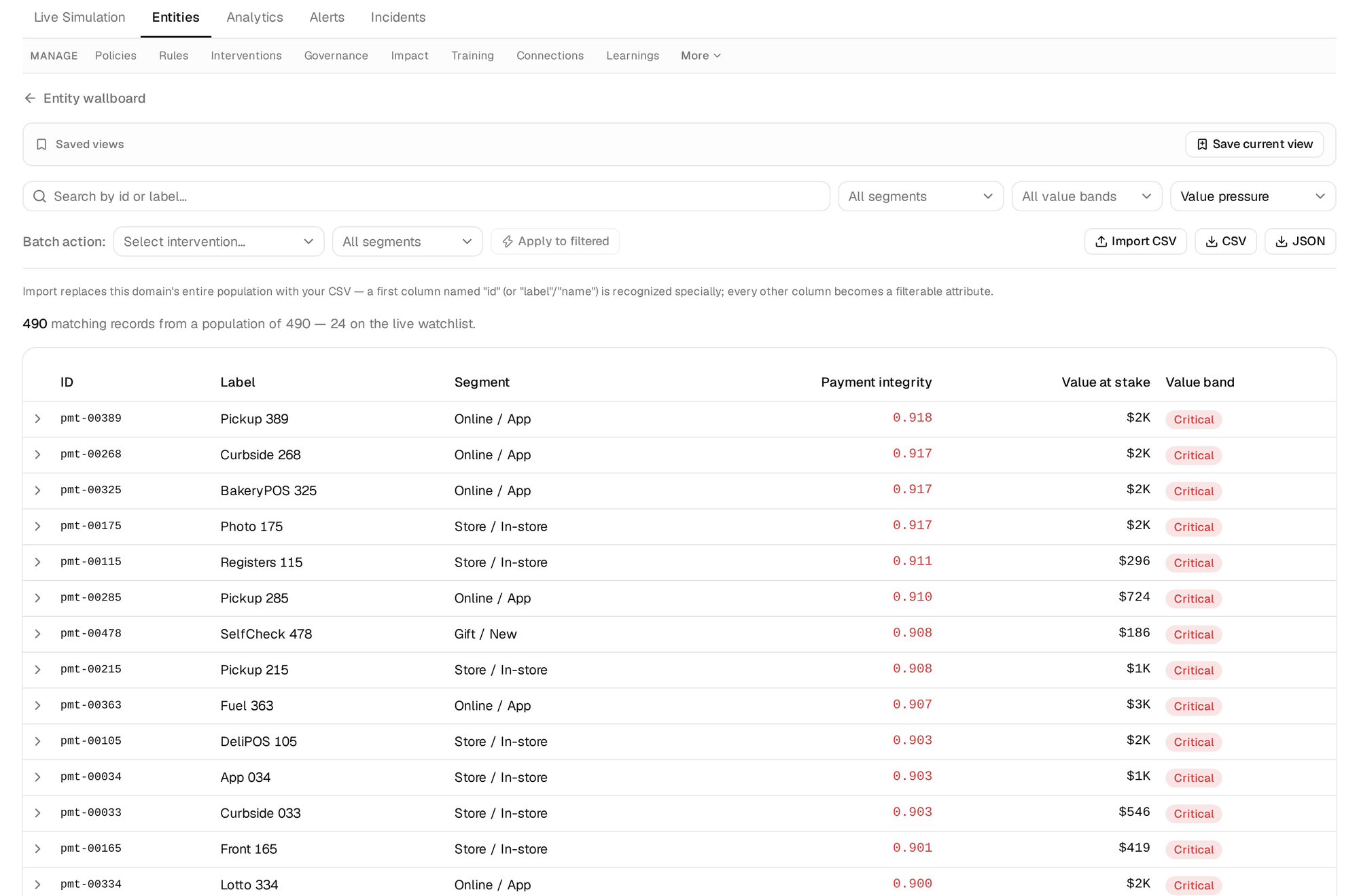 Fictional reference world: OgMart
Localization
State dimensions and intervention costs are domain configuration, so a grocery chain, a fashion retailer and a fuel network each define their own. Currency is stated explicitly on every cost surface.
One till, twelve stores: how a pattern spreads
A problem on one entity reaches the others along the relationships between them.
What acting early would have saved
A counterfactual on one OgMart payment entity, with the dollars at stake.
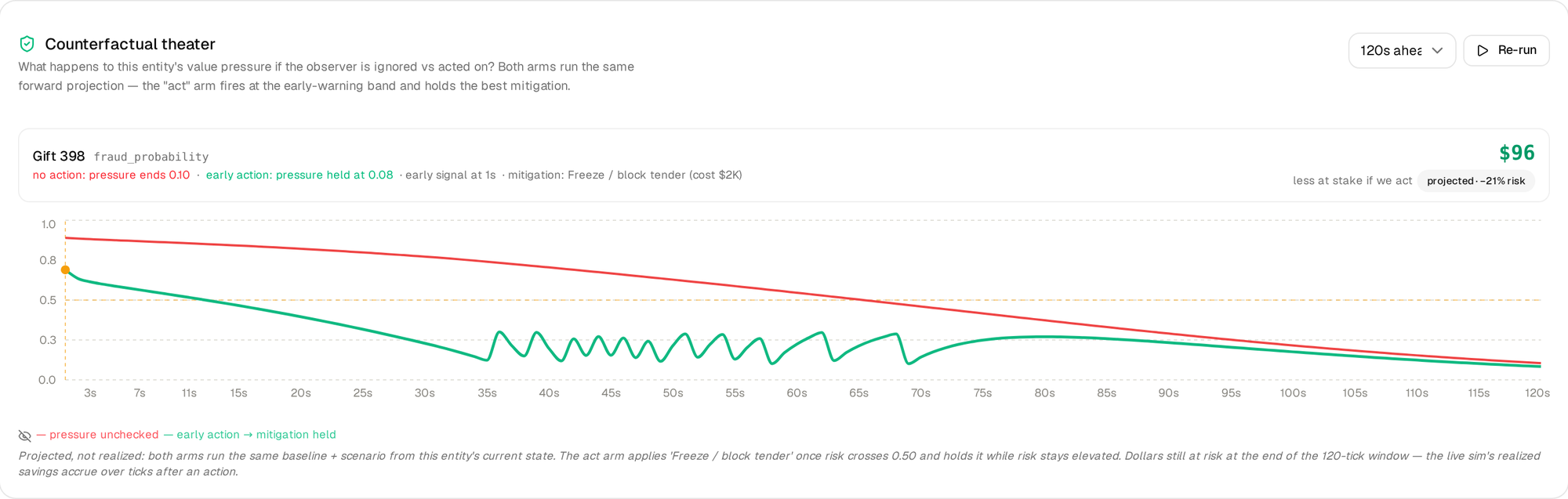 Fictional reference world: OgMart
Watch a hundred stores at once
See the queue, the evidence and the priced action on the reference world, then on your own region.