What-if analysis: two questions nobody can answer today.
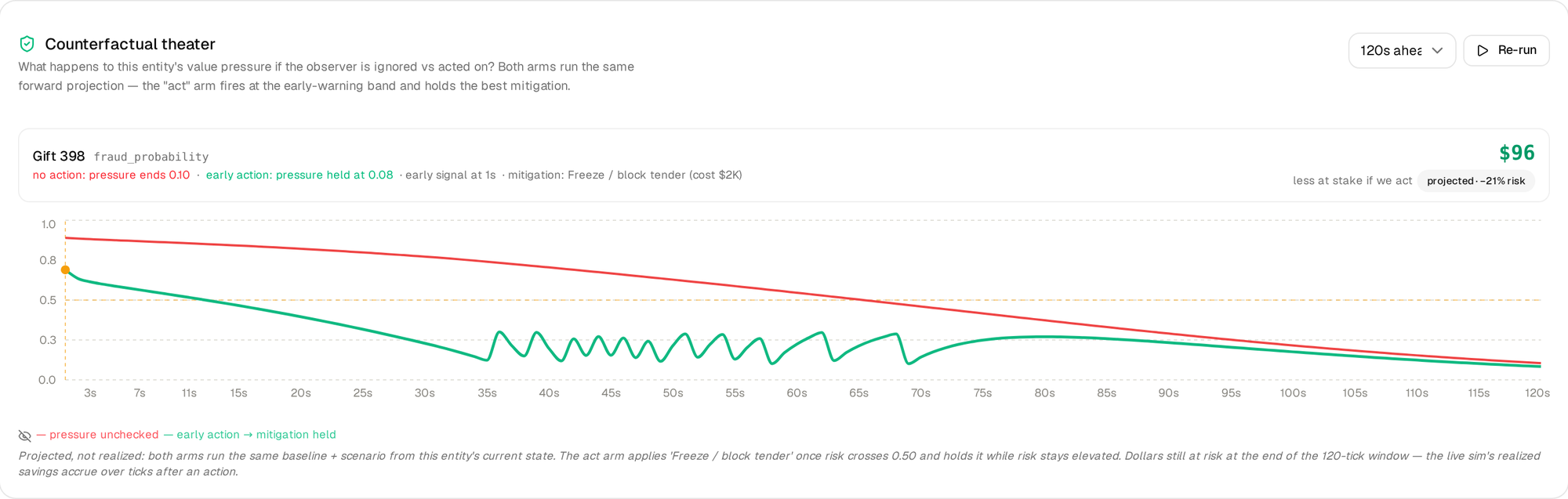
Two questions teams struggle to answer: what would have happened if we had acted earlier, and what will happen if we act now? AnantState answers both by running the model forward and showing the two outcomes side by side, not by arguing about it.
In plain termsReplay the past with a different choice, or preview the future with one.
Replay and forecast
Counterfactual replay: “what if we had acted?” Replay an entity’s actual history, then run the same window again with an intervention applied at a chosen point. The two trajectories sit side by side. It is how a team builds intuition about its own decisions, and how a post-incident review stops being an argument about opinion.
Use it for:
- post-incident review of a real case
- calibrating how much an intervention is actually worth
- teaching a new analyst what the signals look like before they matter
Forward what-if: “what happens if we act now?” Fork the current live state and roll it forward on the horizon. Change the lever. Watch it recompute.
Use it for:
- choosing between interventions on a live case
- showing a decision-maker the consequence before asking for approval
- stress-testing a policy change against the current population
 Fictional reference world: OgMart
It runs in your browser
Same engine, no round trip.
One engine runs on the server and in the browser. The browser what-if is not a simplified model, not a cached screenshot and not a request to a demo environment. It is the same engine running the same world definition your production instance runs.
- No latency tax. Dragging a lever recomputes in milliseconds, because the computation is local.
- No network exposure. A forecast of a live entity does not have to leave the analyst’s machine.
- No environment drift. A demo cannot quietly diverge from the thing you would deploy, because it is the same artifact.
- It works on a plane. The engine is in the page; it does not call home.
Why this changes the evaluation
The demo is the product.
Most platform demos are a video of someone else’s data. This one lets you change the lever and watch the consequence on a world of 100 stores. It invites the hard question, what if it is wrong here?, which is where the evaluation discipline lands. And nobody who has moved a lever themselves accepts a slide deck again.
Branch from the present
From one live state, run it as it is or with an action applied, then compare.
Replay one of your own incidents
Bring a past case. We will replay it with and without the action you wish you had taken.