The platform infers the decision. You decide what is allowed to happen next.
For each situation, AnantState ranks the actions you could take and shows what each costs and what it should achieve. By default a person chooses and applies it. Where you decide to allow it, some actions can be applied automatically, within limits you set, with a full record, and stopped whenever the evidence is unclear.
In plain termsIt recommends, with prices. You decide how much it is allowed to do on its own.
At a glance
Ranked and priced
Each candidate carries its cost, its effect and the cost of waiting.
Permission per type of action
Never a single on/off switch.
A brake for unclear cases
When the evidence disagrees, automation stops and asks a person.
“A person decides” is a fine place to stay
Many actions should never be automated, and that is a normal setup.
The default: ranked, priced, human-applied
What most teams run, and why it is the right place to start.
| Action | Cost to act | Effect over horizon | Cost of waiting | Constraint check |
|---|---|---|---|---|
| Block the tender type | 40 | −310 exposure | 210 | Within policy |
| Manual review | 65 | −260 exposure | 210 | Within policy |
| Monitor only | 0 | 0 | 210 | n/a |
| Do nothing | 0 | 0 | 210 | n/a |
A human chooses and applies. The applied action, the actor and the outcome are recorded. Why start here: the value in the first months comes from ordering and pricing, not from removing the human. Teams that automate before they trust their own ordering automate the wrong thing faster.
The autonomy ladder: five levels, granted per action class
| Level | The platform | The human | Typical use |
|---|---|---|---|
| 1 · Inform | Surfaces state and divergence | Everything | First weeks of a new domain |
| 2 · Recommend | Ranks and prices actions | Chooses and applies | The standard configuration |
| 3 · Approve | Prepares the action and holds it | One-click approval | High-volume, low-variance actions |
| 4 · Auto-apply within limits | Applies actions inside declared limits | Reviews exceptions and the log | Mature, well-measured actions |
| 5 · Auto-apply with review | Applies and reports | Post-hoc review and audit | Highest-volume, lowest-cost actions |
Authority is granted per action class, not globally. “Review an account automatically up to a value of X” and “block a tender type automatically” are different grants with different limits, budgets and audit requirements. A platform with one autonomy switch forces a business to choose between doing nothing and doing everything.
What makes autonomous execution governable
Five controls, all enforced.
| Control | What it does |
|---|---|
| Explicit grant | An action class is not automatable until the business enables it, by name. |
| Limits | Per-action ceilings on value, frequency and scope. Outside the limit needs a human. |
| Budgets | Spend ceilings per domain and per period, enforced by the platform. |
| Conflict gate | If the evidence is contentious, the action is held for a human regardless of level. |
| Full attribution | Every automatic action records the policy that authorized it, the inference that produced it, and its outcome. |
The conflict gate is the most important control and the least common. An automated system that acts confidently on contradictory evidence is worse than one that does nothing, because it acts at scale. Where evidence conflicts, ours stops and asks.
Why autonomy is defensible here
Autonomous action is dangerous when the decision is generated by a system nobody can interrogate. It is tractable when the decision is derived and can be reconstructed. Because AnantState is built on explainable AI rather than a language model:
- The action was inferred from explicit state and evidence, not composed as text.
- The same inputs produce the same action, so an automatic decision is reproducible.
- The reasoning chain that produced it is retrievable after the fact.
- The thresholds, limits and policies that authorized it are inspectable, versioned artifacts.
You cannot audit a generative decision. You can audit a derived one. That is what makes levels 4 and 5 a governance conversation rather than a leap of faith.
A recommended play, with its price and its brake
Ranked candidate actions with cost and return, and a notice that holds autonomous action when the evidence disagrees.
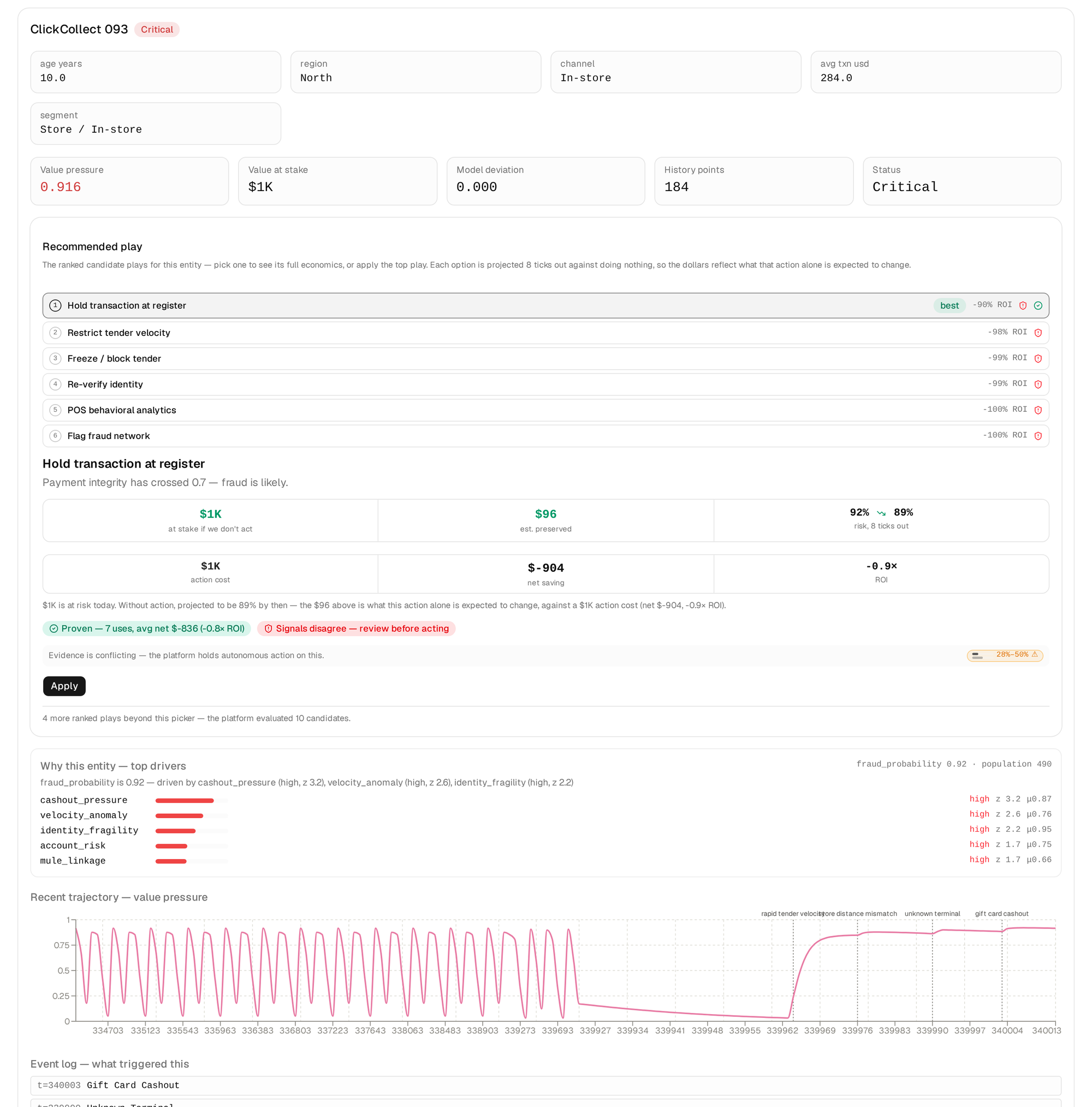 Fictional reference world: OgMart
Write the authority policy for one action class
Start with one action and one limit. We will show how the grant, the budget and the conflict gate behave on the reference world.