Nothing is generated. Every answer can be traced.
AnantState is not a chatbot and it is not built on a language model. It does not write answers; it works them out from your data and shows its working. The same inputs give the same answer, and you can follow any conclusion back to the facts behind it.
In plain termsA language model produces fluent text that is hard to check. AnantState produces a conclusion with its evidence attached, so a person or an auditor can check it.
At a glance
Worked out, not written
The same facts always give the same conclusion.
It does learn, within limits
The learned part is small, adjustable and visible. We never claim otherwise.
Four things you can test
Everything it uses is visible, its working survives, you can see how much the model changed the answer, and every action has an owner.
You own the rules
Your vocabulary, thresholds, actions and who may approve what are all yours.
Five things that are not true of this platform
| Not this | Because |
|---|---|
| Not token-based | There is no tokenization, no context window, no per-token cost. State is numeric and continuous. |
| Not a language model | Nothing is generated as text. Conclusions are computed from state, evidence and rules. |
| Not a prompt interface | Behavior is not steered by phrasing. The domain definition and the evidence determine it. |
| Not non-deterministic in its reasoning | The same state and the same evidence produce the same conclusion. Reproducibility is a requirement, not a nicety. |
| Not priced per query | There is no meter attached to thinking. Inference cost does not scale with how much you ask. |
This matters commercially, not only philosophically:
- Auditable. An auditor asks why. “The model said so” is not an answer. A derived conclusion has a chain.
- Reproducible. A decision can be re-run and must produce the same result. Regulated functions cannot work with a reasoning path that changes between runs.
- No fabricated content. There is nothing to hallucinate. The platform does not compose prose about your business; it computes state and reports evidence.
- Predictable latency and cost. Inference has no relationship to the length of a question, and it cannot be slow because another customer is busy.
- No external dependency. Your reasoning does not depend on a third-party model that may be retired, retrained or repriced.
Four commitments, not a label
“Explainable AI” is often a slide. We treat it as four testable properties.
There is a learned component. We are not going to hide it.
Some vendors claim “no AI” and mean “a spreadsheet”. Others claim “AI” and mean “we cannot explain it”. We are neither.
There is a learned component. It is a specialized predictive model that corrects a known behavioral baseline. It is not generative, it is not a language model, and it is bounded: its influence is weighted, visible per dimension, and reported against a baseline you can check.
A purely rule-based system would be simpler to explain and much less useful. A generative black box would be more fashionable and impossible to govern. We chose the middle: learned where it adds information, attributable everywhere. That is the whole argument for why this can be deployed in a regulated function.
Your rules, your thresholds, your actions, your authority
Most platforms ship an inference engine and ask you to accept its judgment. Here, the business defines the reasoning.
| The business defines | Meaning |
|---|---|
| The ontology | The vocabulary of entities, state dimensions and relationships |
| The dynamics | How state moves, in the business’s own terms |
| Thresholds and bands | What counts as elevated, for whom, and where the lines sit |
| The interventions | What actions exist, what they cost, what they may affect |
| The decision horizon | How far ahead the platform must be right |
| The action framework | Which actions need a human and which may be automatic |
| The escalation policy | What happens when evidence conflicts or confidence is low |
The platform contributes the forward position, the evidence and the discipline. The authority stays with you. Where you want automation you grant it explicitly, per action class, with limits, never as a global switch. See next best action.
What to ask any vendor that says “AI”
Six questions that separate the categories
- Is any of this generated text, or is it all derived? If generated, what stops it inventing something?
- Show me the chain from a conclusion back to its inputs.
- Will the same inputs produce the same conclusion tomorrow?
- How much of the answer came from the learned component, and how do I change that weighting?
- What happens to my reasoning when the vendor retires a model version?
- Where is the token meter? If there is one, you are buying inference, not a system.
We will answer all six on your data.
Why this entity: the drivers, in the open
Each conclusion shows the drivers behind it and the events that triggered it. Nothing is generated.
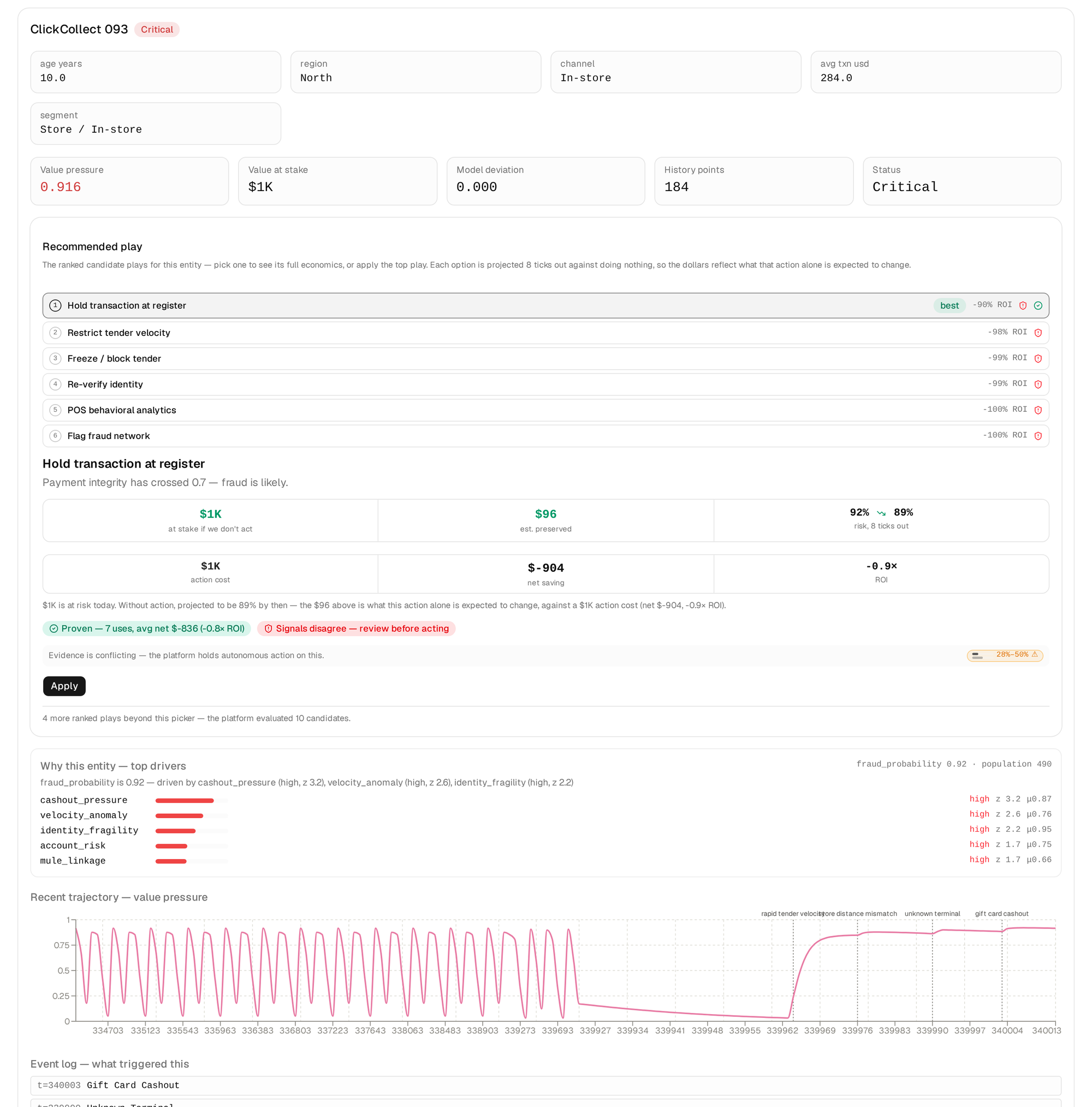 Fictional reference world: OgMart
Ask the six questions of us first
A technical session is the fastest way to see a derived conclusion traced back to its inputs, on a world you recognize.