Every conclusion arrives with its evidence, and its disagreement.
When several sources of information disagree, most tools average them into one score. AnantState keeps them apart: how much supports a conclusion, how much merely could, and how much the sources contradict each other. Disagreement is not hidden; it is flagged for a person to look at.
In plain termsTwo reports saying “fine” is different from one saying “fine” and one saying “alarm”. We show you which it is.
The problem with a weighted score
A weighted score answers “how much, on balance”. It cannot answer the questions a practitioner actually asks: which sources are driving this? Is this confident, or the average of strong disagreement? What would change my mind?
Averaging destroys exactly the information that decides whether a case is real. Two sources at 0.5 agree, weakly. One at 1.0 and one at 0.0 average to the same 0.5 and mean something completely different: an outright conflict a human should look at.
Same average, different case · illustrative
Two sources, weak and in agreement
- Average
- 0.5
- Conflict
- Low
Two sources, flatly contradicting each other
- Average
- 0.5
- Conflict
- High: a person should look
Four numbers instead of one
| Quantity | The plain-English question |
|---|---|
| Belief | How much evidence supports this conclusion? |
| Plausibility | How much could support it, if the unknowns resolved favorably? |
| Uncertainty | How much is genuinely undecided? |
| Conflict | How much do the sources contradict each other? |
A high conflict reading is a feature, not a defect. It means this case is contentious, and a person needs to look. Systems that hide conflict produce confident averages of contradictory inputs: maximum false assurance.
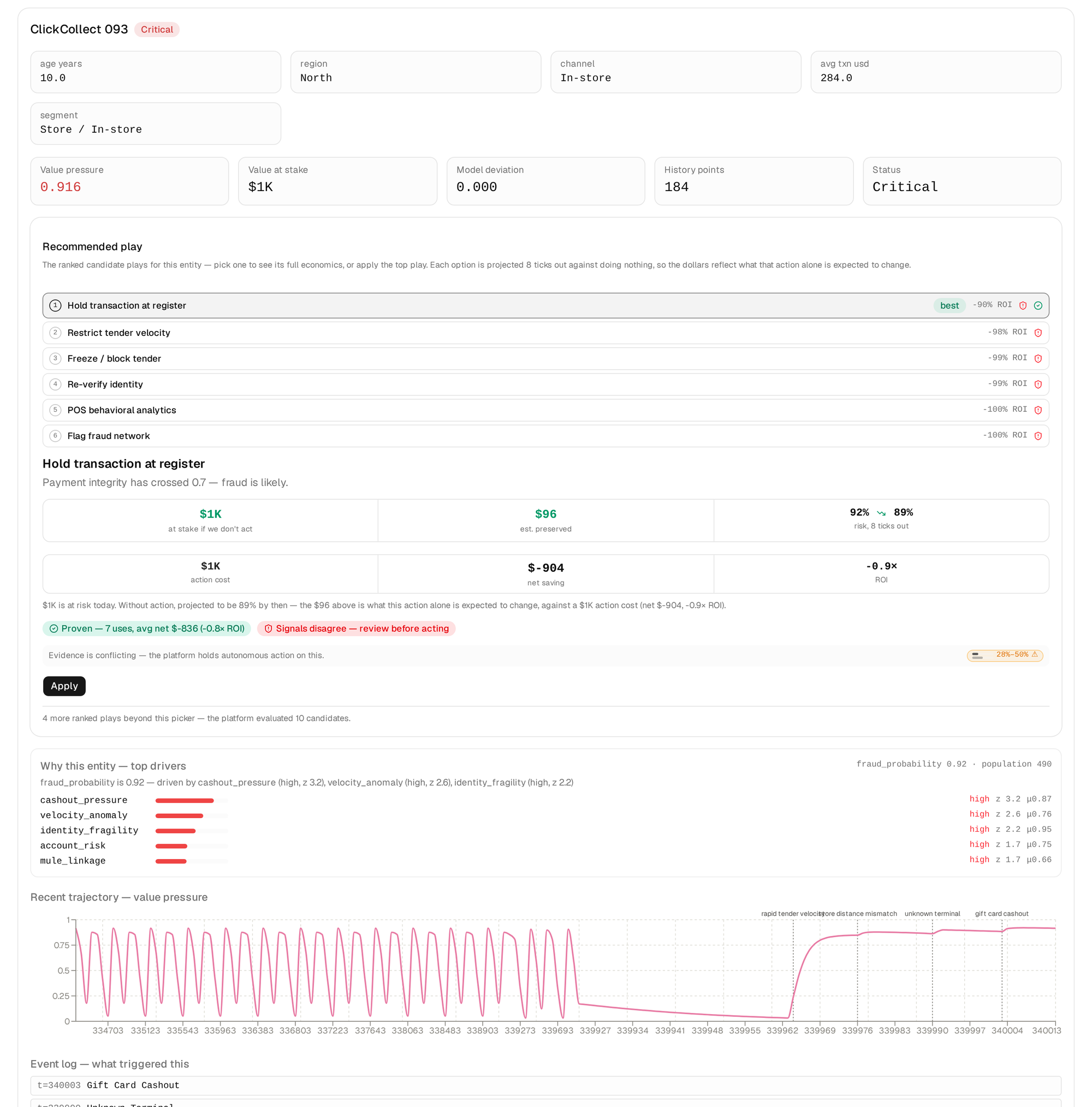 Fictional reference world: OgMart
From an alert back to the event that caused it
- Alert provenance traces a raised alert back through the rule, the state dimensions and the contributing evidence.
- Alert receipts record what was decided about the alert and by whom, so “we looked at it and did nothing” is a recorded decision rather than an absence.
- Entity evidence shows the current belief, plausibility, uncertainty and conflict for that entity’s band, beside the learned weight.
- Attribution records the acting user on every action.
Together these answer the audit question, why did the system think that, and what did you do about it?, without anyone reconstructing it from memory.
Explainability of the model, not just the rules
Rules are easy. Models are the hard part.
The learned part is a bounded correction
Its contribution is visible as a magnitude relative to the domain baseline.
The correction is shown per metric
A practitioner can see which state dimension the model is leaning on, and by how much.
The internal state is inspectable
The model’s hidden signals are surfaced in the interface, so it is not a black box with a friendly label.
The trust weight is configured, not hidden
A domain states how much the residual is trusted.
The model’s own record states where it fails
See decision horizon.
We do not claim there is no learned component. We claim the learned component is attributable: bounded, visible, weighted, and reported against a baseline.
Look for the case where the sources disagree
In the session we find the highest-conflict entity on the reference world and read its evidence together.