Before you act: what changes, how much, and what else it touches.
An action can look right on its own and still be wrong for everything around it. Before you act, impact analysis shows what the action changes, what it costs, and what else it touches.
In plain termsBefore you press the button: what happens, what does it cost, and who else is affected?
1 · What does it change?
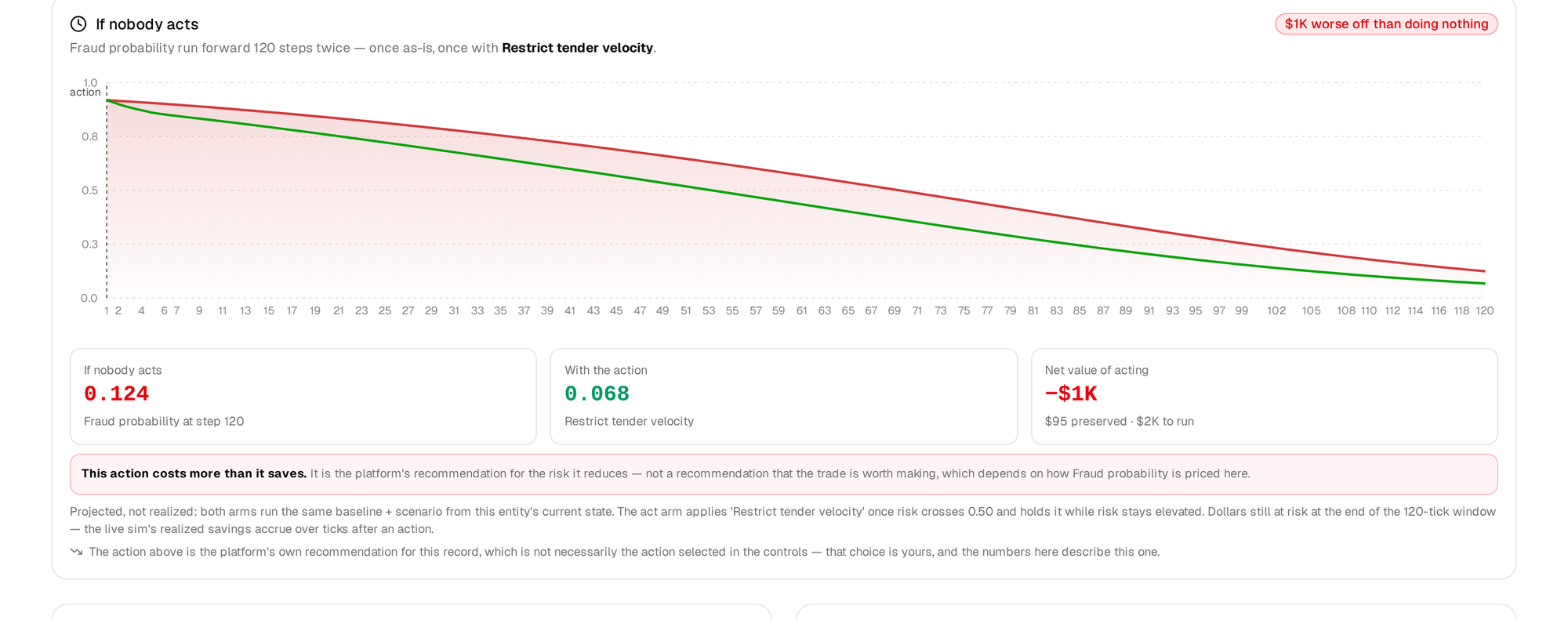
The platform runs the entity forward with and without the intervention applied, at the declared horizon, and reports the expected difference on the primary dimension. It is a computation, not an estimate from a table of averages: it is the entity’s own forward path, branched.
2 · What does it cost?
| Quantity | What it is |
|---|---|
| Cost to act | The intervention’s price: a property of the intervention, consistent everywhere. |
| Expected effect | The modeled movement in the primary dimension over the horizon. |
| Cost of waiting | What the entity’s exposure becomes if nothing is done over the same horizon. |
Presented together, the decision stops being a judgment call and becomes arithmetic: cost 40, expected reduction 310, cost of waiting 210.
Three numbers, side by side · worked example, USD
Cost to act
40
The intervention’s price
Modeled effect
−310
Exposure, over the declared horizon
Cost of waiting
210
What exposure becomes if nothing is done
“Do nothing” is on the list, with a price. Monitor-only and do-nothing both carry the cost of waiting, which is what makes the conversation short.
3 · What else does it touch?
The part most tools omit, and the part experienced operators ask about first.
Because entities are modeled with their relationships (ontology), an intervention’s consequences can be traced beyond the entity it was applied to:
- Upstream and downstream. Acting on a supplier affects the lines it feeds.
- Shared drivers. Several entities may share a cause; fixing one may not fix all, or may fix all.
- Blast radius. If this action is wrong, what is the extent of the damage, and how hard is it to unwind?
- Neighborhood. Which entities look like this one, and are they about to do the same thing?
Impact analysis without a cascade view produces decisions that are locally optimal and globally wrong.
Ranked actions, because a business rarely has one option
| Action | Cost | Effect over horizon | Cost of waiting | Notes |
|---|---|---|---|---|
| Block the tender type | 40 | −310 exposure | 210 | Fastest; affects legitimate volume |
| Manual review | 65 | −260 exposure | 210 | Slower; preserves legitimate volume |
| Monitor only | 0 | 0 | 210 | The priced default |
| Do nothing | 0 | 0 | 210 | Same as above, but now it is a decision |
That last row is the point. “Nothing” is on the list with a price attached, which is what makes an escalation conversation short. The figures above are an illustrative worked example.
 Fictional reference world: OgMart
Rehearsal, not prediction worship
Impact analysis is a model output, and it is held to the discipline of every other conclusion in the platform.
In the product this surface is called Impact. Engineers can read how it works on the impact engine page.
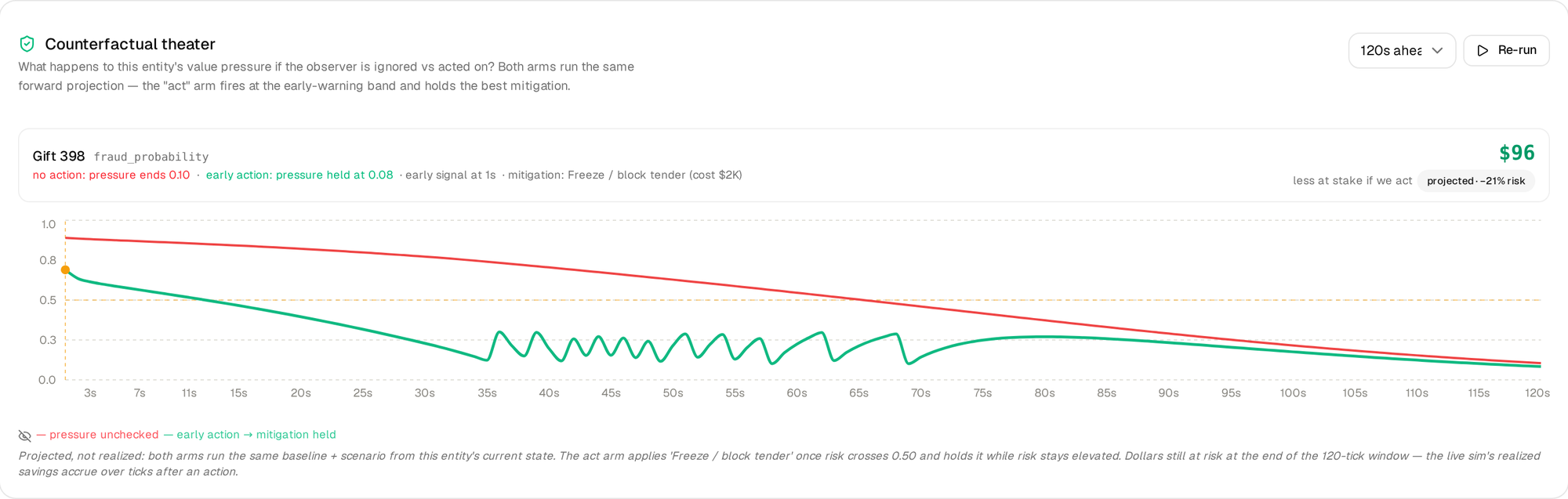
Acting and not acting, side by side
The same entity run forward twice: ignored, and acted on early.
 Fictional reference world: OgMart
Price an action before you take it
Bring one intervention you are unsure about. We will show its effect, its cost, the cost of waiting, and what else it reaches.