Every action has a price. So does waiting.
Most tools stop at “this looks bad”. The useful questions are: what does fixing it cost, what does ignoring it cost, and which action pays for itself? AnantState puts those three numbers side by side.
In plain termsCost to act, cost to wait, and the likely benefit: on one screen.
“Is it worth doing?”
Three numbers, side by side
Cost to act
The action’s price. It is a first-class property of the action, so it is consistent across every case it is recommended for.
Modeled effect
How much the action is expected to move the main measure over the chosen time frame, computed by running the engine forward with the action applied.
Cost to wait
What the item’s exposure grows to if nothing is done over the same time frame.
The comparison is what makes the decision discussable. “Investigate this account” stops being a judgment call and becomes: cost 40, expected reduction in exposure 310, cost of waiting 210. Currency and assumptions are always stated on the surface that shows the number.
Three numbers, side by side · worked example, USD
Cost to act
40
The intervention’s price
Modeled effect
−310
Exposure, over the declared horizon
Cost of waiting
210
What exposure becomes if nothing is done
“Do nothing” is on the list, with a price. Monitor-only and do-nothing both carry the cost of waiting, which is what makes the conversation short.
Cost-aware does not mean unlimited
Because actions have prices, they can be budgeted:
- Per-domain budget ceilings, so a busy week cannot cause an unbudgeted spend spike
- Limits, so the platform will not recommend an action outside the bounds you set
- Notification limits, so the volume of surfacing is itself rationed to what a team can absorb
A recommendation engine without a spend ceiling is a liability. Ours has one, enforced by the platform.
What we claim, and what we do not
We claim: every action carries a cost; every recommendation arrives with its modeled effect and the cost of waiting; spend is bounded by configured limits; the arithmetic is inspectable.
The finance questions, answered structurally
Is the spend bounded?
Yes. Budgets and limits are enforced by the platform.
Is the return measured or asserted?
Modeled today, with the assumptions visible. The mechanism to measure realized return against it is in the product through long-term memory; we will not present a modeled number as a result.
Can we stop?
Yes. Actions are explicit, recorded and attributable, and the platform is read-mostly by default.
The three numbers, in the product
The forward path with and without the action, and the net value of acting.
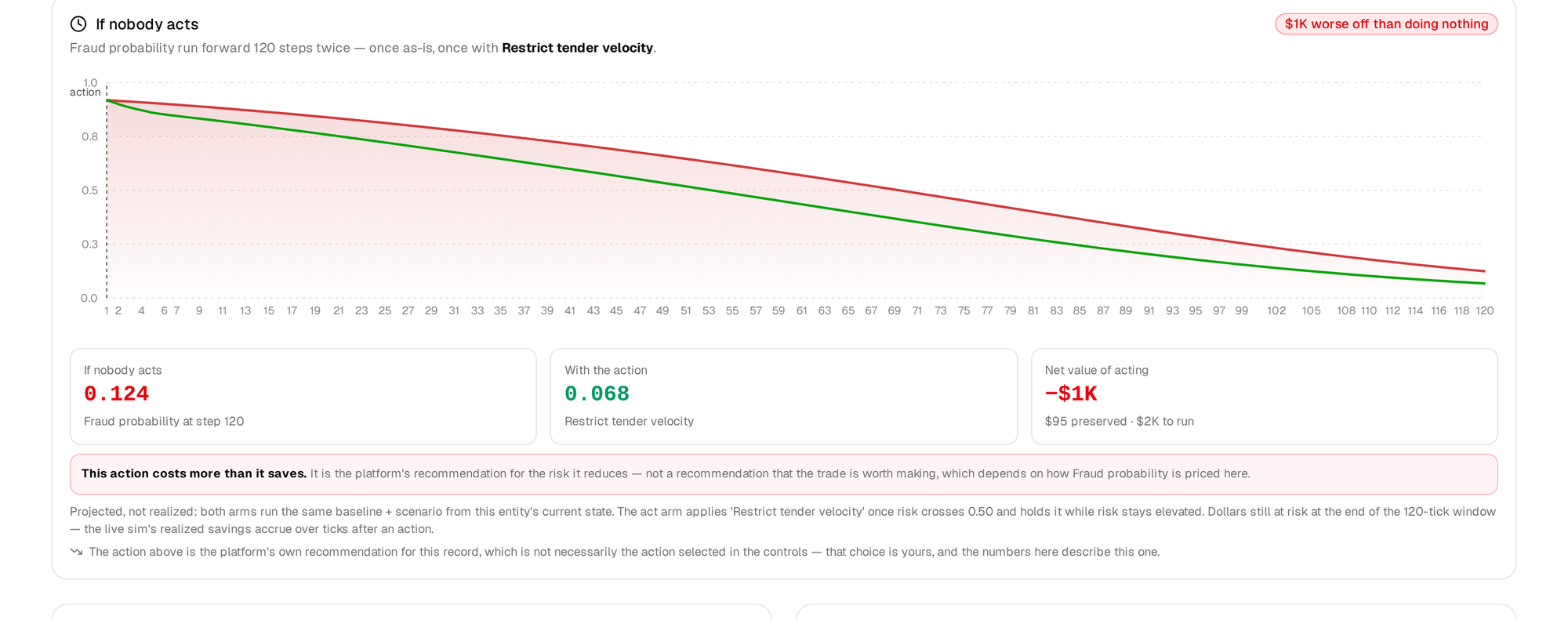 Fictional reference world: OgMart
Put a price on the action you keep deferring
Bring one action and its cost. We will show its modeled effect, the cost of waiting, and the break-even.