Be able to prove what you knew, when you knew it, and why you decided.
Most tools make decisions nobody can reconstruct later. AnantState keeps the evidence, the reasoning and the person behind every decision, so the answer to “why did we do that?” is a lookup, not an investigation.
In plain termsA record that answers “what did we know, and who decided?”
“How do we know, and who signed?”
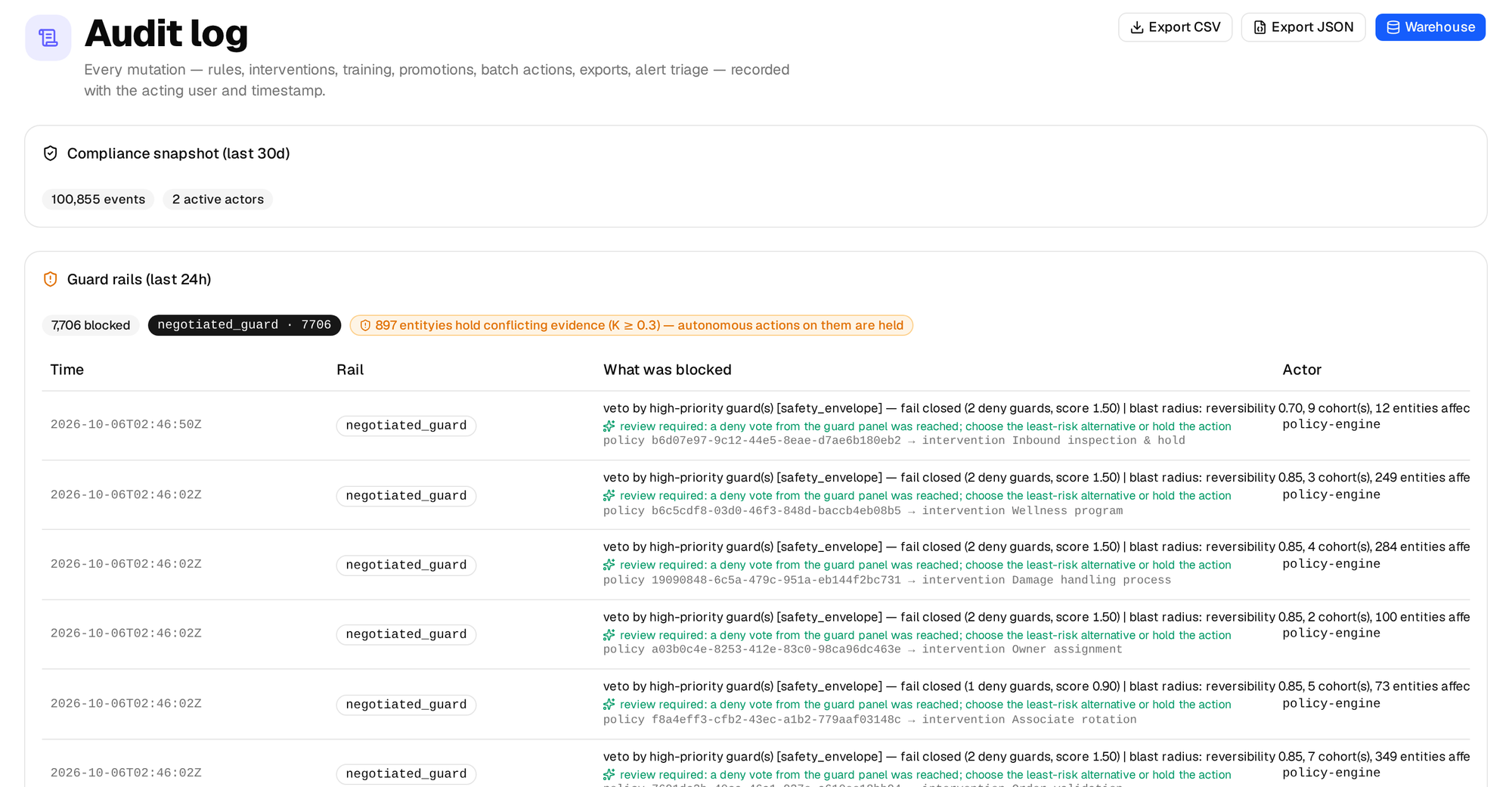 Fictional reference world: OgMart
The four artifacts an auditor is given
The control that makes the rest credible
A gate that refuses, by default.
No model reaches serving without passing a promotion gate that refuses in a fixed order: corpus provenance, divergence, performance against the simple guess, and whether the chosen time frame was ever measured. A human can override, and the override is recorded with reasons.
That is the difference between governance as a document and governance as a control. The platform’s resting state is “this model may not serve”, and someone has to actively change that.
The failure mode most platforms cannot see
If a model is trained on data the previous model generated, it will score brilliantly and know nothing. It is a closed loop that looks like progress.
AnantState records which teacher produced each training row, counts the unattributed rows, and flags corpora that are too self-referential to certify. Such a corpus disqualifies a promotion. It is the first check in the gate, ahead of every performance question, because a model trained on its own output can pass every performance check there is.
Show your validation function the model record
Bring the person who has to sign. They will see a record that includes the failures.