A digital twin built for decisions, not for pictures.
Most digital twins are 3D models of physical things. This one is a live model of how your operation is doing: for every store, account or machine it tracks where it stands and where it is heading. You can then ask “what happens next?” and “what would have happened if we had acted?”
In plain termsA copy of your operation that runs forward in time, so you can try a decision on the copy before you try it on the real thing.
What makes a twin decision-grade
Four properties. Without all four it is a picture.
It contains the right nouns
Stores, lanes, accounts, machines, cases, shipments, pathways. Not sensors and not servers: the things a decision is made about.
It is live and continuously corrected
A model of your business is wrong the moment it is built. The twin is corrected by your events as they arrive, so it drifts toward reality instead of away from it. The correction is bounded, weighted and visible.
It predicts, and it states its own error
A twin that cannot say how far ahead it is trustworthy is a visualization. This one declares a decision horizon, measures its forward error against a naive baseline, and reports the point beyond which it should not be believed.
It is branchable
Fork the twin at any point: roll the current state forward, roll it forward with an intervention applied, or replay history and run the same window differently. Every branch is a decision rehearsal.
Six uses, in the order teams adopt them
| Use | The question it answers |
|---|---|
| Early warning | Which entity is drifting, how far, and by when? |
| Impact analysis | If we act, what changes, and what else does it touch? |
| What-if | What happens next, on this state, with this lever? |
| Counterfactual replay | What would have happened if we had acted then? |
| Policy rehearsal | What does this policy change do across the whole population, before we ship it? |
| Onboarding and training | What do these signals look like before they matter? |
The last two are undervalued. A twin lets a new analyst build judgment on last quarter’s real history instead of waiting for the next incident, and lets a policy change be tested against the current population rather than argued about in a committee.
Read more: early warning, impact analysis, counterfactuals and what-if.
The twin is a configuration, not a build
You define the world.
A twin is defined by its ontology: the entities, their state dimensions, the relationships between them, the dynamics that move state, the interventions available and what they cost, and the horizon that matters. All of it is data the business owns and can change.
- A new world is configuration. A different business unit, a different site, a different industry. The world changes; the platform does not.
- Nothing is hidden in a rebuild. If the twin behaves unexpectedly, the definition is inspectable. There is no model artifact you cannot open and no retraining you cannot schedule.
What this is not
| Not this | Why it matters |
|---|---|
| A 3D or CAD visualization | Geometry does not answer a business question. |
| A static simulation built once | It would be wrong within a week. |
| A BI model of last quarter | A twin has a present and a future, not only a past. |
| A generic “AI model” of your business | No ontology, no horizon, no action, no audit. |
| An unmonitored automation engine | The twin recommends and rehearses. The business authorizes. |
See one running
OgMart is a fictional 100-store retailer that runs as one live twin across 15 departments. It exists so you can fork it, change a lever and watch the consequence, without anyone’s real data.
Branch the twin and compare
One entity, two futures: no action and early action, with the dollars at stake in each.
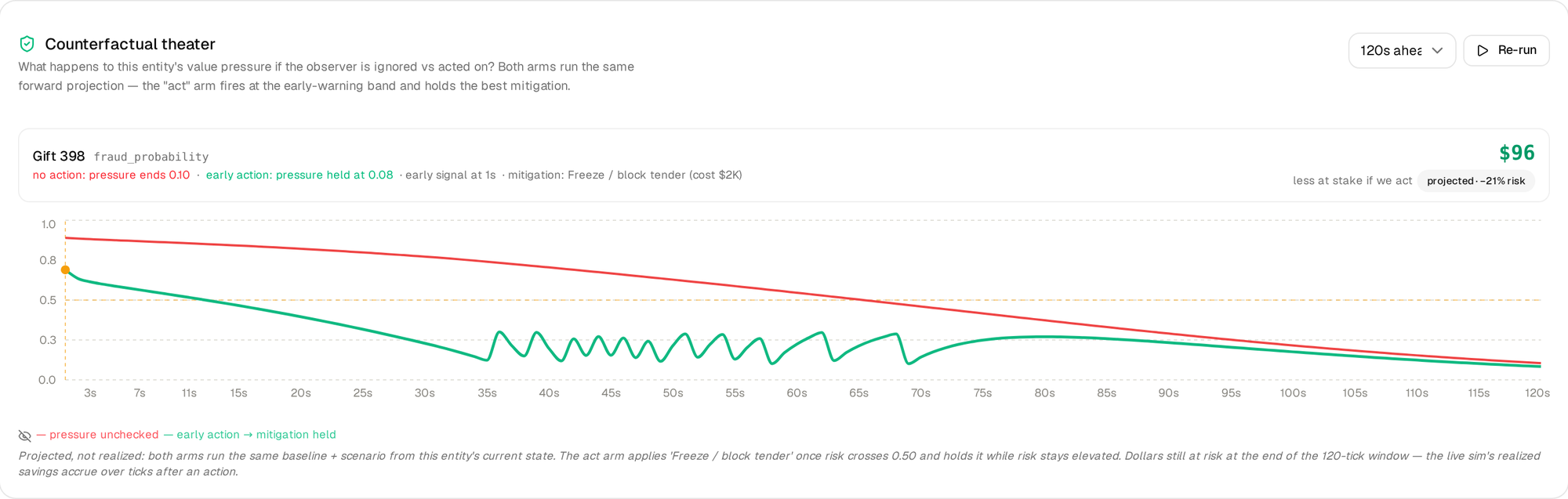 Fictional reference world: OgMart
Fork a twin and change a lever
The fastest way to understand a decision-grade twin is to move one. We will do it on the reference world, then on your domain.