An account is a relationship with a history, not a row with a status.
An account is a relationship with a history, not a row with a status. AnantState tracks where each account, merchant or case is heading, with the evidence and the cost of acting attached.
In plain termsSee how each account is moving, not just what flag it has today.
1 · What are the things you manage?
The distinction that matters here: an entity is usually a relationship with a history.
- Account
- Member
- Merchant
- Card
- Device
- Case
- Dispute
- Branch or channel
2 · What changes over time, and why?
| State | Baseline drivers | Unexpected drivers |
|---|---|---|
| Fraud posture | Seasonality, channel mix, product behavior | New attack patterns, account takeover, mule activity |
| Credit posture | Tenor, payment cycle, utilization | Employment change, hidden leverage, behavior break |
| Dispute pressure | Volume, product, partner | Merchant failure, systemic event |
| Investigation load | Case arrival rate | A single organized pattern creating correlated cases |
3 · What goes wrong today?
In the buyer’s own words.
4 · What changes with AnantState?
- Account state, not account status. A position and a direction, with the driver attributed.
- Conflict surfaced, not averaged. Where sources disagree the case is marked contentious: precisely the case an experienced analyst should see, and the one a score hides.
- Priced actions. Step-up authentication, a hold, a manual review, each with a cost, so the false-positive trade-off becomes an explicit, reviewable decision rather than a rule someone set two years ago.
- Ranked by value at stake, so the queue is defensible to an operations leader who owns a servicing budget as well as a loss budget.
- A model record your validation function can read, including the horizons where the model does not beat naive persistence.
5 · What can you see in the demo?
A synthetic financial-services world with accounts, merchants and cases: entity ranking by value at stake, evidence fusion with conflict, priced interventions, and counterfactual replay of a case.
All reference worlds are fictional and labeled. We do not use real customer data and we do not imply it.
Regulatory notes
- Explainability is a regulatory expectation in most jurisdictions, and an engineering property here: every conclusion carries its evidence.
- Model governance maps to model risk management expectations: documented purpose, measured performance against a defined baseline, a recorded promotion decision, and drift monitoring.
- Data residency and tenancy are deployment questions. See governance and control.
Authority, per action class
A step-up or a hold can be automatic within limits you set, and stops for a person when the evidence disagrees.
A case with its evidence and its price
Shown on the OgMart payments domain (fictional); the financial-services world uses the same surface.
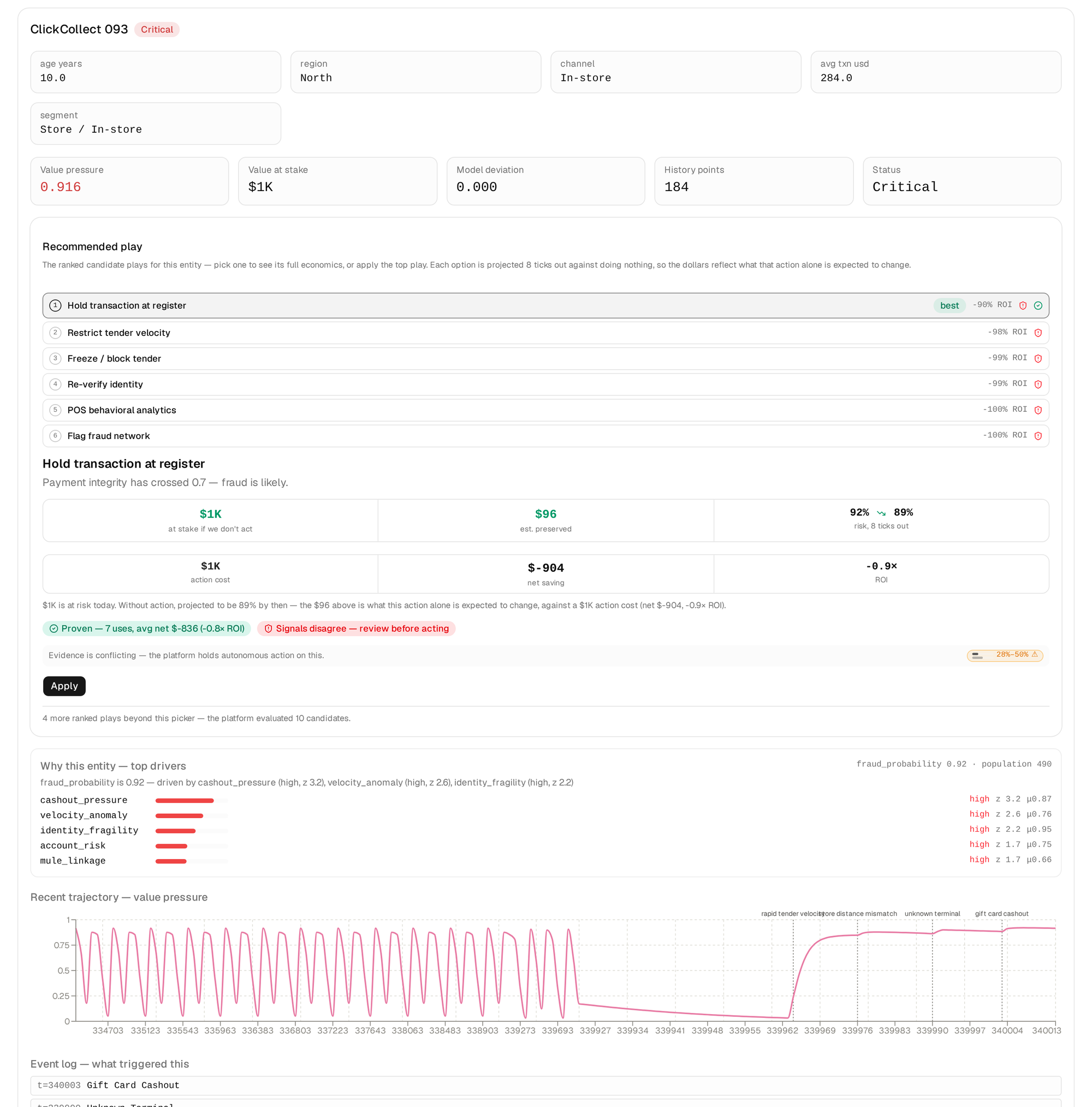 Fictional reference world: OgMart
Price the false positive
Bring a rule whose false-positive cost nobody has measured. We will price it against the cost of the loss it prevents.