Detect and anticipate: stop finding out after it has cost you.
A threshold tells you something has happened. Tracking where each thing is heading tells you something is happening, which is earlier and usually still cheap to fix.
In plain termsSpot the drift while it is still a small problem.
“When do we find out?”
The platform works out where each item should be by now, from how it normally behaves plus a small learned correction, and compares that with where it actually is. The gap is the signal, and it appears before any fixed limit is crossed, because limits are fixed and behavior is not.
What “earlier” means, precisely
No vague promises about timing.
We do not claim a fixed number of hours of extra warning. Warning depends on the item’s normal behavior, the noise in your feed and the time frame the model can actually hold in your domain. What we do claim, and can demonstrate:
- The signal is continuous, not binary. A magnitude and a direction, not a flag.
- Forward error is measured and published at your chosen time frame against the simple guess that nothing changes, so you can see how far ahead the model is genuinely useful before you rely on it.
- Where it does not beat the simple guess, the model record says so. In that domain we have not made you better at anticipating, and you should not buy it for that.
That third point is why this page can be trusted.
What you get on screen
- Items ranked by pressure. Ordered by how much money is at stake, not by how unusual they look.
- Band and trend for each item. Where it stands and which way it is moving, with the reason named.
- Time at risk. How long an item has been elevated, which separates a sudden spike from a slow slide.
- Gap against expected. How far the selected item is from where it should be.
- Rising and falling, both surfaced. Anticipation is not only about bad news.
| If the symptom is | The domain to start with |
|---|---|
| Losses discovered weeks later | Payment and tender integrity, refunds, chargebacks |
| Churn noticed at renewal | Member or account engagement state |
| Degradation noticed at failure | Machine or asset condition state |
| Backlog discovered at month end | Case or claim throughput state |
“We already have anomaly detection”
“Anomaly detection asks “is this unusual?” A state model asks “where is this going?””
The first gives you a score against a static notion of normal. The second gives you a position, a direction, and a measured distance ahead at which that position is trustworthy. They answer different questions, and only one of them prices a decision.
What anticipation looks like on screen
Entities ordered by pressure and value at stake, so the one drifting fastest and costing most is on top.
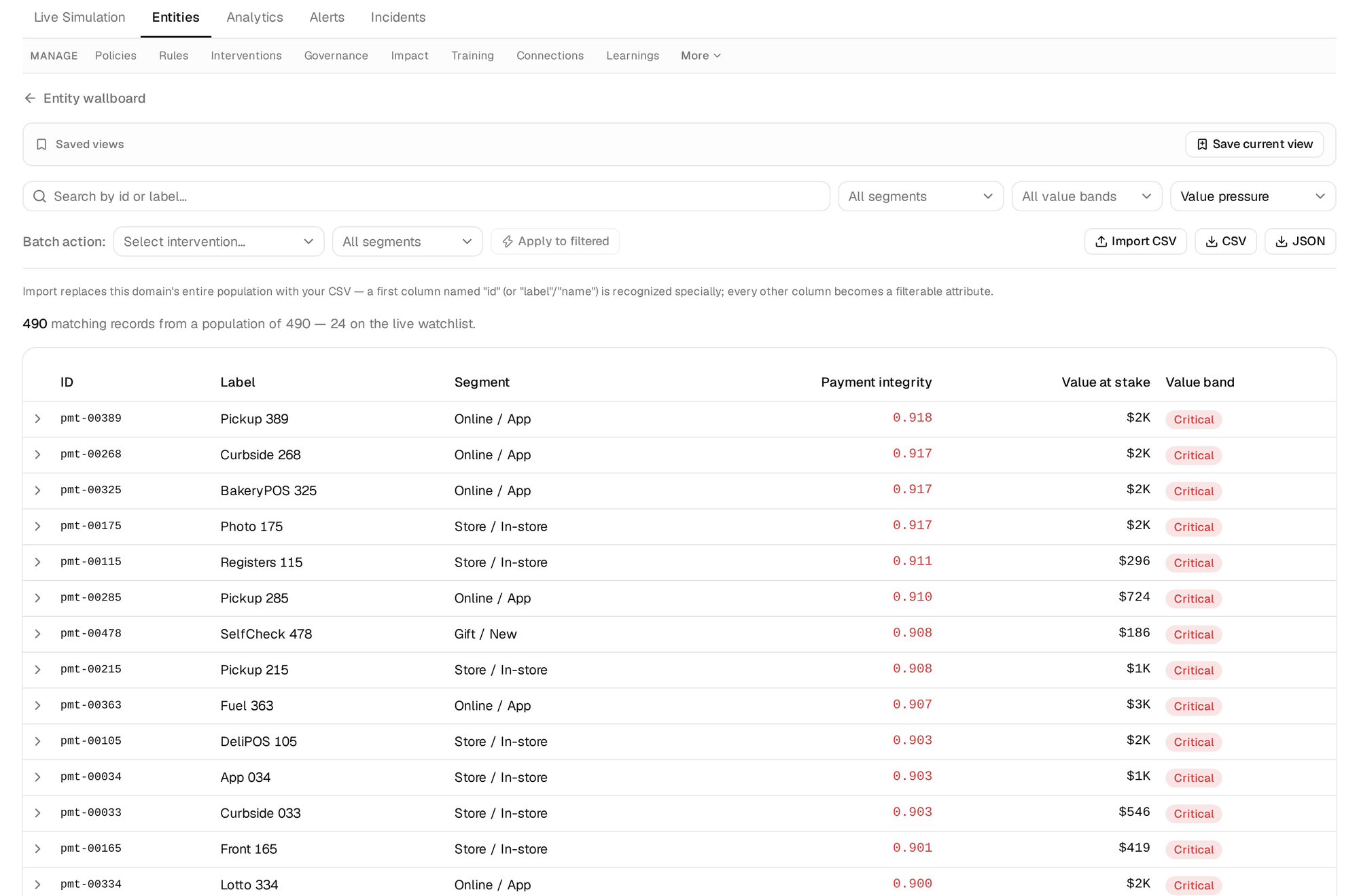 Fictional reference world: OgMart
Find out when your items started drifting
Bring a month of events from the domain where losses surface late. The model record will say how far ahead it holds.