Low latency: if reasoning is slow, it does not happen.
A forecast nobody waits for is just a report. AnantState answers fast enough to use in a meeting: take the current situation, change one thing, and see the effect immediately, even inside your own web browser.
In plain termsFast enough to try an idea while the room is still looking at the screen.
Three costs of slowness
Latency is a product feature, not an engineering metric.
Reasoning stops being interactive
At seconds per query, an analyst asks one question and moves on. At tens of milliseconds they explore: try five interventions, discard three, understand the problem properly. Exploration is the actual work.
Reasoning stops being collaborative
A decision meeting cannot wait for a computation. If the answer is not there while the room is looking at the screen, the decision reverts to opinion and the platform becomes an appendix to the meeting.
Latency breaks the trust loop
When recomputation is instant, people test the model directly: pull a lever, watch it respond, build intuition about where it is reliable. When it is slow they never do, and the model stays a black box however well it is documented.
Microsecond inference. Honest decision latency.
What we measure, what we do not, and why the distinction matters.
- median, one state-advance step
- ≈ 14 µs
- p99, the standard model
- < 45 µs
- median, the precision variant
- 70–140 µs
One inference step for one entity, in-process, on a 12-core desktop-class CPU (AMD Ryzen 9 3900X), from the platform’s built-in benchmark, across the compiled domains. Not a network figure and not a throughput figure.
The state-advance step is small by design: it corrects a declared baseline instead of predicting everything from scratch, so there is very little computation per entity. That is what makes microsecond-scale inference real, and what lets state advance on every event rather than on a schedule.
Where the time goes · only the measured stage has a number
- Stage 1Event arrivesYour transport and networkMeasured at your shape
- Stage 2State advancesOne inference step≈ 14 µs median, under 45 µs p99
- Stage 3Reasoning and policyEnvelope, spread, guardsMeasured at your shape
- Stage 4Action leavesYour system, your networkMeasured at your shape
Conditions. One state-advance step for one entity, the standard model, run in-process on a 12-core desktop-class CPU (AMD Ryzen 9 3900X), taken from the platform’s own built-in benchmark. The “precision” variant of the model measures about 70 to 140 µs median.
Four capabilities that do not exist without it
| Capability | Requires |
|---|---|
| Dragging a lever | Continuous recomputation as an input changes |
| Comparing branches | Several forward paths computed while the comparison is being discussed |
| Population rehearsal | A policy change evaluated across many entities, now |
| Live escalation | A case being argued while the numbers are on screen |
Not by cutting corners
How it is achieved, stated as properties.
- The model is small by design. It corrects a declared baseline rather than predicting everything from scratch, so there is far less computation per entity.
- The world is per-entity, not per-query. State is maintained continuously, so answering a question is advancing state, not rebuilding the world.
- Reasoning runs where the decision is made. The engine executes locally, including entirely inside a browser, so a forecast of a live entity does not leave the analyst’s machine and there is no network hop in the loop.
- Cost is predictable. Reasoning has no relationship to the size of a question, and it cannot be slowed by another customer’s workload. There is no shared queue between tenants.
- Determinism is preserved. The same state and evidence produce the same conclusion: fast and reproducible.
What a practitioner notices: a what-if recomputes as a lever moves, a counterfactual replay renders as a comparison the room can discuss, a rehearsal of a policy change across the whole population is interactive rather than an overnight batch, and heavy reasoning by one analyst does not slow the stream another team is watching.
Honest notes
Forward projections you can re-run at will
Change the horizon, press re-run, and the comparison recomputes.
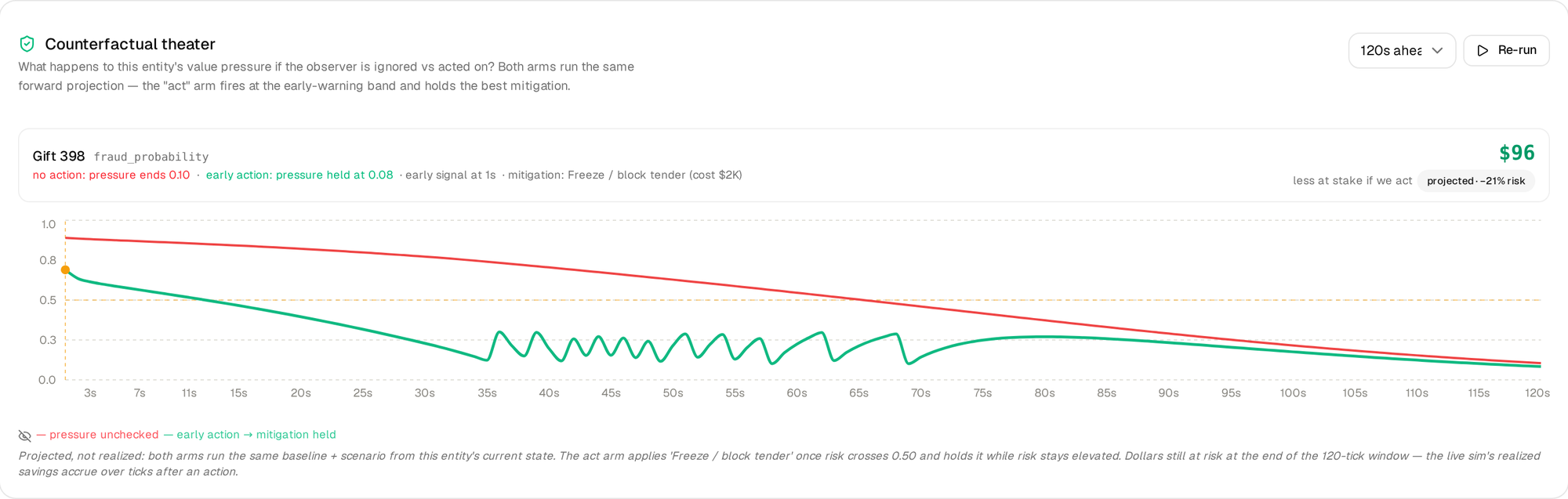 Fictional reference world: OgMart
Move a lever and watch it recompute
The what-if runs in your browser on the same engine as production. Bring the hard question: what if it is wrong here?